Journal of Advanced Studies: Sciences,Technologies, Humanities, Arts.
ISSN:Pending Vol.1 Issue: 1
Published online on September, 23, 2024
Copyright 2023, CDUV Claustrum Doctoralis Universum Vitalis
Download Article: https://claustrumdoctoralis.org/wp-content/uploads/2024/11/Optimisation.pdf
Jesús Francisco Carpio-Mendoza1
Abstract
The piezoelectric effect of quartz has revolutionised the generation and transmission of electronic signals. This phenomenon allows certain materials to convert mechanical energy into electrical energy and vice versa, where this brings improvements of the quality and creating precision in transmisi´onreception processes of signals in electronic devices. Implementing the piezoelectric effect with electronic quasi-relaxation and mathematical analysis through Bulnes transforms, digital signals can be optimised, enhancing their quality and reliability of the signals. This paper is a motivation on direct applications of the pair integral transforms of Prof. Dr Francisco Bulnes-Aguirre (a recognized mathematician) to the electronic materials like semiconductors widely applied in electronics science.
1 Introduction
A few weeks ago, Prof. Dr Francisco Bulnes-Aguirre, a mathematician by training, shared with me an article on Bulnes transforms in the study of materials, focusing particularly on quasi-relaxation. Below, I present a brief summary of this excellent study, along with a link for a more detailed read. Beyond the experimental studies conducted by prestigious universities and institutes on quasi-relaxation in materials, especially metals, a methodology is proposed based on functional analysis and integral transforms. This methodology facilitates the study of the phenomenon through its energy and provides a spectral representation of quasi-relaxation. A couple of integral transforms are considered, addressing the corresponding hereditary integrals of relaxation and creep functions. These functions establish the meta-stable state of the specimen within a brief time interval following the application of the initial load test. For further details, see the paper [1].
From the above, the idea for this article emerges, in which I explore the use of quartz and Likewise, the piezoelectric effect of quartz has revolutionised the generation and transmission of electronic signals. This phenomenon allows certain materials to convert mechanical energy into electrical energy and vice versa, which is essential for creating precision electronic devices. By integrating the piezoelectric effect with electronic quasi-relaxation and mathematical analysis through Bulnes transforms, digital signals can be optimised, enhancing their quality and reliability.
2 The Piezoelectric Effect and Electronic Quasi-relaxation
The piezoelectric effect is an inherent property of certain crystals, such as quartz, which generates an electric charge in response to mechanical stress. When a quartz crystal is deformed, the internal electric charges redistribute, creating a voltage. This capability is applied in various fields, from microphones and loudspeakers to crystal oscillators in clocks and communication devices. The stability and precision of quartz frequency make it an essential component in modern electronics.
Electronic quasi-relaxation refers to a phenomenon where a system, upon excitation, does not immediately return to its equilibrium state. In the context of quartz, this property allows the crystal to retain some of the applied energy, affecting the oscillation frequency and consequently the quality of the generated signal. This is crucial for signal modulation, as it enables dynamic adjustments to the output frequency, facilitating adaptation to different operating conditions.
Likewise, a study related to the behavior of electrons in the relaxation and fluence (or creep 2) in a material with high piezoelectric property under relaxation times (fast and slow, τfs, and τps respectively) in [2] consider among many results in spintronics and quantum electronics that calculations indicate coexistence in a non–equilibrium phase of fast, mobile, metallic quasi–electrons dressed by quantum spin fluctuations τfs with slow, localized in polaronic carriers τps. The laser–induced rearrangement of these majority and minority carriers creates a critical non–thermal population of quasi–electrons with strongly–coupled spin–charge degrees of freedom, which drives a simultaneous AFM→FM 3 switching via quantum spin–charge–lattice dynamical coupling.
3 Bulnes Transforms: Mathematical Tools for Signal Analysis in Quartz.
Bulnes transforms are mathematical techniques (see the figure 1) that decompose and analyse complex signals, allowing for the identification of fundamental patterns and components. Their application in generating digital signals from quartz is key, as they assist in filtering noise and optimising frequencies, ensuring that the resultant digital signal is clear and precise. Even can be involved the Wavelet transform to the different windows in a spectral sequence in a complex signal process [3]. This mathematical analysis becomes an indispensable tool for improving the quality of generated signals.
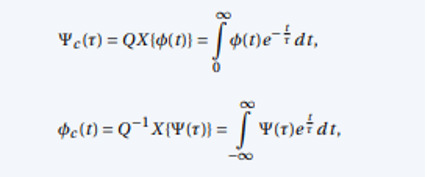
Figure 1: Bulnes transforms of Quasi-relaxation [1][3].
The process of generating digital signals using the piezoelectric effect and quasi-relaxation in quartz involves several steps. Initially, a voltage is applied to the quartz crystal, causing it to vibrate at a specific frequency. This vibration produces an analogue signal, which is then converted into a digital signal through a process of sampling and quantification. Bulnes transforms play a crucial role in this phase, enabling detailed analysis that enhances signal quality and minimises errors during conversion.
Likewise, a concrete concept intimately related with relaxation until quasi-relaxation order from electrons in a carrier is quasi–electron relaxation, which is defined to start of concept of quasi-electron4 . Then the “plastic deformation energy” in the mechanical analogous established to Bulnes transforms in the case of quantum electronics is defined by the charge carrier relaxation mechanism, for example in a crystal. Likewise, the Bulnes- Yermishkin functional of energy Γ(σ− ,t) [3] in this last case will must have a “creep” function that in this case is called fluence function that involves the peak amplitude as function of pump fluence and the time delay (see the figure 2). In this analysis is used a correlation of quasi-electron relaxations, because is necessary consider the initial charge.
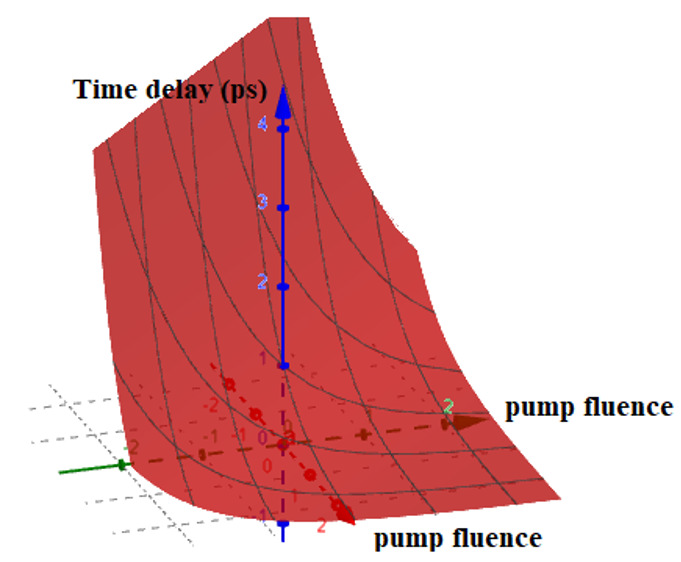
Figure 2: Fluence function that involves the peak amplitude as function of pump fluence and the time delay. Here is considered in experimental studies the femtosecond pump-probe technique.
4 Technological Applications
The interaction between the piezoelectric effect, electronic quasi-relaxation, and Bulnes transforms has a wide range of technological applications. In the telecommunications industry, precision in generating digital signals is fundamental for effective data transmission. Devices such as quartz watches, sensors, and communication systems rely on these interactions to operate efficiently and reliably. In a world where wireless and high-speed technology is on the rise, improving signal quality becomes a priority.
5 Conclusion
The study of the piezoelectric effect in quartz, alongside the understanding of electronic quasi-relaxation and the use of Bulnes transforms, represents a vital area in research and technological development. As society moves towards a more digitised future, the ability to generate high-quality and precise signals becomes increasingly critical. Understanding and optimising these phenomena not only expands our knowledge of material physics but also drives innovations in the design of electronic devices and communication systems engineering, ensuring a solid foundation for technological advancement.
References
[1] Prof. Dr. Francisco Bulnes, More on Quasi-Relaxation transforms and their applications, Int. J. Adv. Appl. Math. and Mech. 12(1) (2024) 46– 56.
[2] T. Li, A. Patz, P. Lingos, L. Mouchliadis, L. Li, Correlating Quasi-Electron Relaxation with Quantum Femtosecond Magnetism in the Order Parameter Dynamics of Insulating Manganites, Phys.Rev.B 95 (2017) 224432.
[3] Bulnes, F. , Stropovsvky, Y. and Yermishkin, V. (2012) Quasi-Relaxation Transforms, Meromorphic Curves and Hereditary Integrals of the Stress-Deformation Tensor to Metallic Specimens. Modern Mechanical Engineering, 2, 92-105. doi: 10.4236/mme.2012.23012.
1Centro de Estudios Estrat´egicos del Baj´ıo, Guanajuato, M´exico. Email: j_carpio@cestbajio.edu.mx Paper Communicated by Prof. Dr. Francisco Bulnes
2Here we have used the term fluence to the creep (studied in continumm mechanics), to the electronic contexto f the piezo-electric effect in a material with high
3insulating/lattice–distorted/antiferromagnetic → metallic/undistorted/ferromagnetic in a semiconductor component.
4This defined as a quantum mechanical model of physical properties of electrons that can move almost freely through the crystal lattice of a solid, where a quasi-electron is a quasi-particle that has the same charge and spin as a “normal” (elementary particle) electron, and like a normal electron, it is a fermion.